


Introduction: I Thought Writing Good Articles Was Enough
When I started blogging, I believed one thing very strongly: if I wrote high-quality articles, Google would automatically rank them. Like many beginners, I thought good writing alone was enough to bring traffic. So I spent hours creating content.
I researched topics, wrote detailed paragraphs, and tried my best to make every article useful for readers. I believed that hard work and helpful content would eventually attract visitors from Google Search. But that did not happen.
Even after publishing multiple blog posts, my traffic was almost zero. Days passed without clicks, impressions, or meaningful growth. I kept opening Google Search Console and analytics dashboards, hoping to see improvement, but most of the time, nothing changed. At first, I blamed my writing skills.
I thought maybe my articles were not good enough, or perhaps my blog design was the problem. But after spending more time learning about SEO and blogging, I discovered the real issue. I was writing content that nobody was searching for. That realization completely changed the way I approached blogging.
Instead of targeting topics people actually searched on Google, I was choosing random ideas based only on what I personally wanted to write. The problem was not content quality alone — the problem was a lack of keyword research. That is when I learned the importance of Keyword Research for Free and how powerful it can be for beginner bloggers.
Keyword research helped me understand:
- What people are actively searching for
- Which keywords are easier to rank for
- What type of content does Google prefer
- How beginners can find low-competition opportunities
- Why do some articles get traffic while others stay invisible
Once I started focusing on keyword research before writing articles, my blogging strategy became much smarter. Instead of guessing topics randomly, I began creating content based on real search demand, and the best part is, “You do not need expensive SEO tools to start learning Keyword Research for Free.”
Many beginners think they must buy costly tools before they can rank on Google, but that is not true. Several free methods and tools can help you find great keywords, analyze competition, and discover content ideas without spending money.
In this guide, I will share the exact process I personally use for Keyword Research for Free, including beginner-friendly strategies, free tools, common mistakes to avoid, and practical tips that can help you find keywords with real traffic potential.

What is Keyword Research?
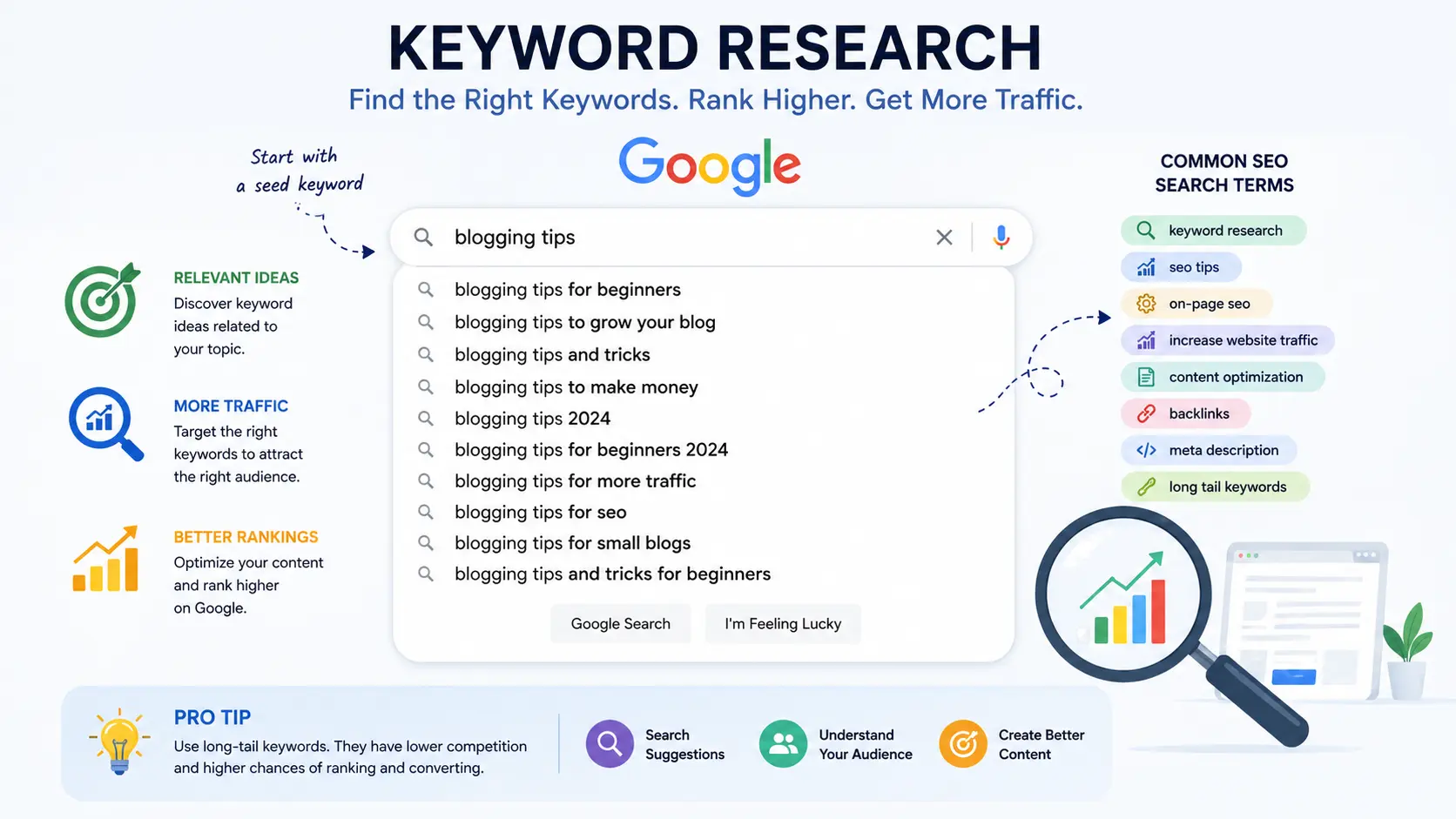
Keyword research is the process of finding the exact words and phrases people type into search engines like Google when they are looking for information, solutions, products, or answers.
In simple terms, keyword research helps bloggers understand what people actually want to search for online. For example, when someone types “How to start a blog”, “Pinterest traffic strategy, “Best AI tools for bloggers”, “Keyword Research for Free,” these search terms are called keywords.
Every day, millions of users search for different topics on Google. Some want tutorials, some want product recommendations, and others are searching for solutions to specific problems. Google’s job is to show the most relevant and useful content for those searches. As a blogger, your goal is very straightforward: Create content around keywords that people are already searching for.
This is extremely important because writing random articles without search demand usually leads to little or no traffic. Even high-quality content may struggle if nobody is searching for that topic. Keyword research helps you avoid that mistake. Instead of guessing what readers want, you use real search data to understand:
- What topics are popular
- What questions do people ask online
- Which keywords have traffic potential
- How competitive a keyword is
- What type of content ranks on Google
Once you understand Keyword Research for Free, blogging becomes much more strategic. You stop creating content blindly and start targeting topics that already have an audience. For example, imagine you write an article called:
“My Thoughts on Blogging Motivation.” That topic may not have much search demand.
But if you create content around a keyword like “How to stay motivated while blogging,” you immediately increase your chances of getting traffic because people are actively searching for that exact topic.
This is why keyword research is one of the most important parts of SEO and blogging success. It helps you create content that matches user intent, improves your visibility on Google, and gives your articles a much better chance of ranking.
The best part is that beginners can start Keyword Research for Free using simple tools and smart research methods without purchasing expensive SEO software.
Why Keyword Research is Important
When I first started blogging, I completely ignored keyword research. I believed that publishing more articles would automatically bring traffic over time. So I focused only on writing content without checking whether people were actually searching for those topics. That was a major mistake.
Now, after learning more about SEO and blogging, I consider keyword research one of the most important parts of creating successful content. In fact, doing proper Keyword Research for Free can completely change the growth of a new blog. Here are the biggest reasons why keyword research matters so much.

1. Helps You Get Organic Traffic
Without keyword research, blogging becomes pure guessing.
You may spend hours writing an article, but if nobody searches for that topic, your chances of getting traffic are very low. Keyword research removes that guesswork and helps you understand exactly what people are searching for on Google. This allows you to create content around real search demand instead of random ideas.
For example, if thousands of users are searching for “Keyword Research for Free,” creating a detailed article on that topic gives you a much better chance of appearing in Google search results. The better your keyword targeting is, the higher your chances of attracting consistent organic traffic.
2. Saves Time and Effort
One painful lesson I learned as a beginner was “Writing articles that nobody searches for wastes a huge amount of time.”
Blogging takes effort. Researching, writing, editing, formatting, and creating images can take hours for a single article. If the topic has no search demand, all that effort may produce little or no results. That is why I now validate every topic before writing. I first check:
- Whether people search for the keyword
- How competitive is it
- Whether beginners can realistically rank
- What type of content already appears on Google
This simple habit saves a lot of time and helps focus only on content with traffic potential.
3. Helps Beginners Rank Faster
One of the biggest advantages of Keyword Research for Free is that it helps beginners discover low-competition opportunities.
Large websites usually target highly competitive keywords with massive search volume. Competing directly against established websites can be very difficult for a new blog. However, keyword research helps beginners find smaller and easier keywords that still receive traffic.
These are often called Long-tail keywords, Low-competition keywords, and Beginner-friendly keywords. For example, ranking for a broad keyword like “Blogging”. It can be extremely difficult, but a more specific keyword like:
“Keyword Research for Free for Beginners” may be much easier to rank for.
This strategy helped me get my first Google rankings and slowly build traffic over time.
4. Helps You Understand User Intent
Keyword research is not only about finding search volume. It also helps you understand what users actually want. This is known as user intent. Different keywords represent different goals. Some users are looking for:
- Tutorials and step-by-step guides
- Product recommendations
- Comparisons and reviews
- Quick answers
- Free tools and resources
For example:
- “How to do keyword research” shows informational intent
- “Best keyword research tools” shows comparison intent
- “Free keyword research tools” shows solution-focused intent
When you understand user intent correctly, you can create content that matches what readers expect to see. This improves: Content quality, User engagement, Time on page, Google rankings, and Overall SEO performance.
That is why successful blogging is not just about writing articles. It is about creating the right content for the right audience using smart Keyword Research for Free strategies.
My Biggest Keyword Research Mistakes
If there is one thing I wish I had understood earlier in blogging, it is “Good content alone is not enough if your keyword strategy is weak.”
When I started learning Keyword Research for Free, I realized that many of my blogging struggles were caused by avoidable mistakes. I was working hard, but I was targeting the wrong topics, misunderstanding search intent, and competing against websites far bigger than mine.
Looking back, these mistakes taught me valuable lessons that completely changed my blogging strategy.
1. Choosing Very Broad Keywords
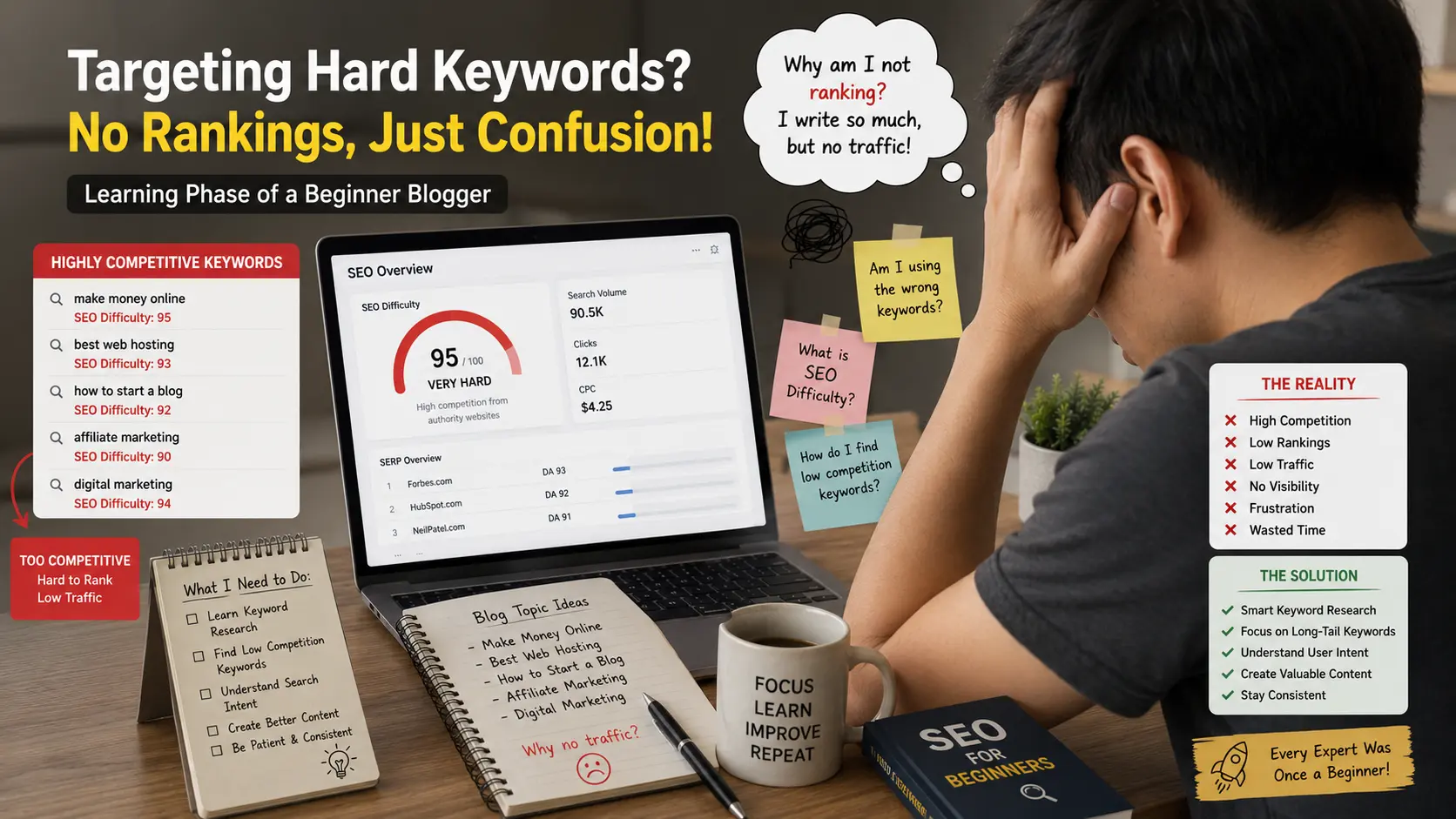
One of the biggest mistakes I made was targeting extremely broad and competitive keywords. I tried writing articles around topics like: “Blogging”, “SEO”, “Make money online”.
At that time, I thought targeting large keywords would bring massive traffic, but I quickly discovered the problem.
These keywords are dominated by huge authority websites with:
- Strong backlink profiles
- Experienced SEO teams
- Thousands of indexed pages
- High domain authority
- Years of trust with Google
For a new blogger, competing against those websites is extremely difficult.
Even if your article is good, Google may still prefer older and more established websites for highly competitive searches. That is why beginners should focus more on: Long-tail keywords, Specific search queries, Lower competition topics, Narrow audience problems. For example, instead of targeting “SEO.”
A beginner may have better success targeting “Keyword Research for Free for New Bloggers.” Smaller keywords often have lower competition and provide a much better chance of ranking.
2. Ignoring Search Intent
Another major mistake I made was ignoring search intent. At first, I only focused on keywords without understanding what type of content Google actually wanted to rank. This caused many of my articles to fail.
For example, sometimes I wrote detailed informational blog posts for keywords where Google mainly ranked: Tool pages, Product pages, Videos, Tutorials, and Comparison articles. Even though my content was helpful, it did not match user expectations.
Google tries to satisfy user intent as accurately as possible. If most users searching for a keyword want a free tool or video tutorial, Google will prioritize those formats. This taught me an important lesson: Before creating content, always analyze the first page of Google.
Check:
- What type of content is ranking
- Whether articles, videos, or tools dominate results
- The structure competitors use
- The questions users want answered
Understanding search intent is one of the most important parts of successful Keyword Research for Free.
3. Not Checking Competition
Earlier, I selected keywords without analyzing competitors. That was another costly mistake. I assumed that if a keyword had good search volume, I should target it immediately. But I later realized that some keywords are almost impossible for new websites to rank for.
Now, before targeting any keyword, I carefully study: The websites ranking on page one, their domain authority, Content quality, Backlink strength, Article depth, and search intent alignment.
If the entire first page is filled with massive authority websites, ranking becomes much harder for beginners. This does not mean small blogs cannot succeed. It simply means smart keyword selection matters.
Sometimes targeting a keyword with lower search volume but weaker competition is a far better strategy for long-term blog growth.
4. Writing Without Research
In the beginning, I mostly chose blog topics emotionally. I wrote about whatever seemed interesting to me personally, without checking whether people were actually searching for those topics.
That approach created many articles with little or no traffic potential. Now, my process is completely different. Instead of writing randomly, I first do Keyword Research for Free to validate the topic properly.
I check: Search demand, Competition level, User intent, Content opportunities, Ranking difficulty. This strategic approach changed everything for my blog.
Instead of hoping articles would perform well, I started creating content based on real search behavior. That helped me make better content decisions, improve SEO performance, and increase my chances of getting consistent organic traffic from Google.
What Makes a Good Keyword?
One of the biggest lessons I learned while doing Keyword Research for Free is that not every keyword is worth targeting, especially for beginners.
In the beginning, I used to pick keywords randomly without checking whether they were realistic for a small blog. That usually led to poor rankings and very little traffic.
Over time, I realized that good keyword selection is not only about search volume. A strong keyword should be realistic, targeted, and aligned with your blog’s goals. Here are the main things I personally look for before choosing a keyword.
1. Low Competition
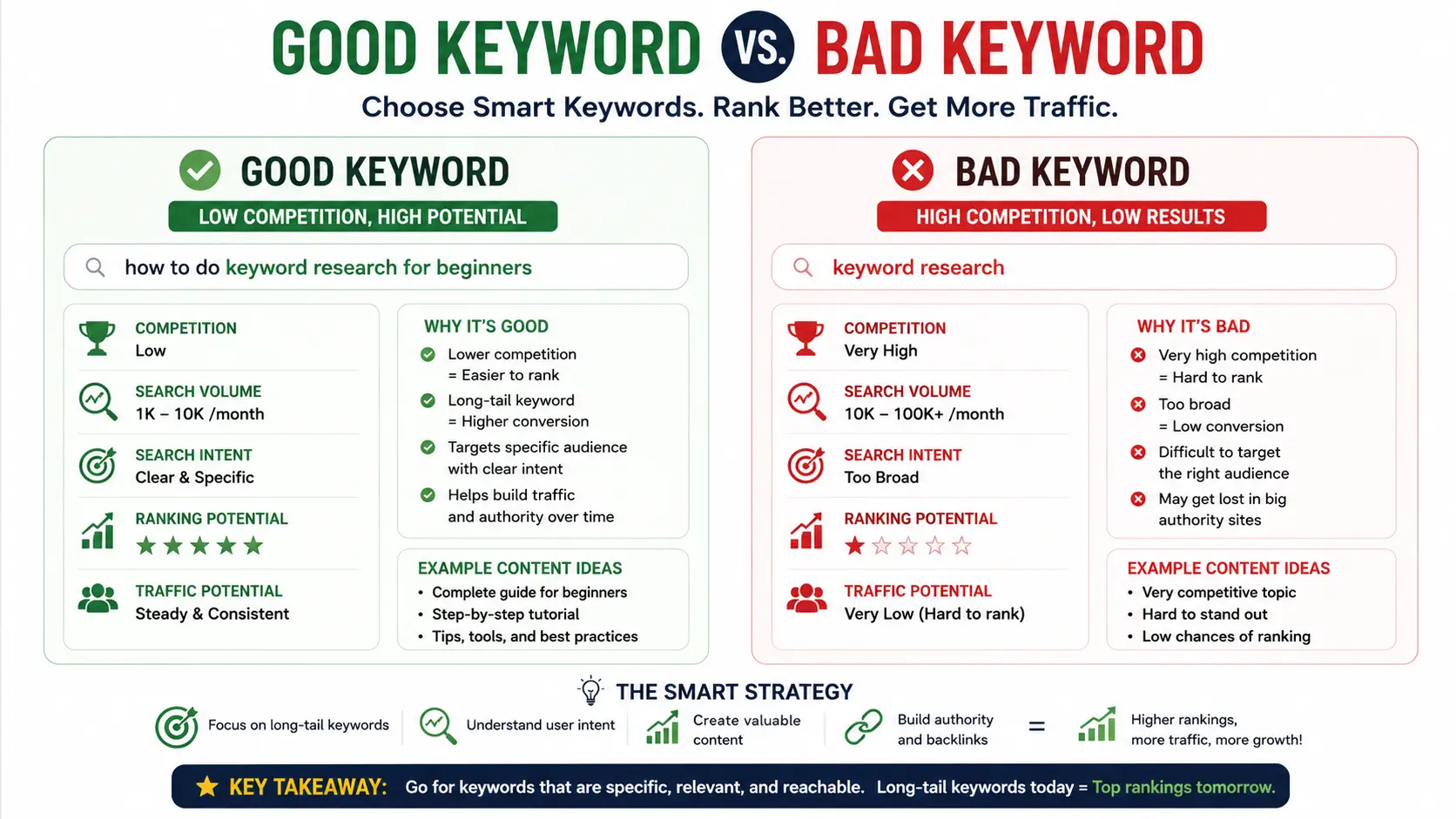
This is one of the most important factors for beginner bloggers. If a keyword is highly competitive, ranking on Google becomes much harder because you are competing against large authority websites with stronger SEO, backlinks, and domain authority.
That is why I prefer keywords where smaller blogs still have a chance to compete. When doing Keyword Research for Free, I usually check:
- What type of websites rank on page one
- Whether smaller blogs appear in search results
- How detailed are the competing articles
- Whether the keyword seems beginner-friendly
If the entire first page is dominated by huge websites, I usually look for a more specific variation of the keyword. For example, instead of targeting “SEO tips,” a beginner may have better success targeting:
“SEO tips for new bloggers.” Lower competition keywords often bring slower but more achievable growth.
2. Decent Search Volume
Many beginners make the mistake of chasing extremely high-volume keywords immediately. I made the same mistake in the beginning. But later, I learned that smaller keywords can still bring valuable traffic, especially for new blogs. Even keywords with 100 monthly searches, 300 monthly searches, and 500 monthly searches can be excellent opportunities if the competition is low.
In fact, targeting multiple smaller keywords is often smarter than competing for one massive keyword. This strategy helps beginner blogs:
- Gain initial rankings
- Build topical authority
- Increase Google trust
- Generate consistent traffic over time
When doing Keyword Research for Free, remember this: A low-competition keyword with moderate traffic is usually better than a high-volume keyword that is impossible to rank for.
3. Clear Search Intent
Another important factor I always check is search intent. A good keyword should clearly show what the user wants. When search intent is obvious, creating useful content becomes much easier because you already understand the reader’s goal. For example: “How to create Pinterest pins.”
This keyword clearly tells us the user wants a tutorial or step-by-step guide. Similarly:
- “Best AI tools for bloggers” suggests comparison intent
- “Keyword Research for Free” suggests educational or solution-focused intent
- “How to start a blog” suggests beginner guidance
Clear intent helps improve:
- Content structure
- Reader satisfaction
- SEO optimization
- Google rankings
If a keyword has confusing or mixed intent, ranking becomes more difficult because Google may not know which type of content to prioritize. That is why understanding intent is a major part of successful keyword research.
4. Relevant to Your Niche
One mistake many bloggers make is chasing random traffic. Getting traffic sounds exciting, but irrelevant visitors usually do not stay engaged with your content. They may leave quickly, avoid clicking on other articles, and reduce overall blog quality signals.
That is why I now focus only on keywords related to my niche and audience. For example, if your blog focuses on: Blogging, Pinterest marketing, SEO, AI tools, Affiliate marketing, then your keywords should stay connected to those topics.
Relevant keywords help you:
- Build niche authority
- Improve internal linking
- Increase topical relevance
- Grow a targeted audience
- Improve long-term SEO performance
Google also prefers websites that consistently publish content around related topics instead of covering completely random subjects.
This is why strategic Keyword Research for Free is not just about finding traffic opportunities. It is about finding the right traffic for your blog.
Best Free Keyword Research Methods I Personally Use
When I first started learning Keyword Research for Free, I believed I needed expensive SEO tools to find good keywords. But over time, I realized that many powerful keyword research opportunities are available completely free. In fact, some of my best blog ideas came from simple free methods that anyone can use.
The key is understanding where real user searches and conversations happen. These are the free keyword research methods I personally use regularly to find blog topics, discover long-tail keywords, understand user intent, and generate content ideas.
Method 1: Google Search Suggestions
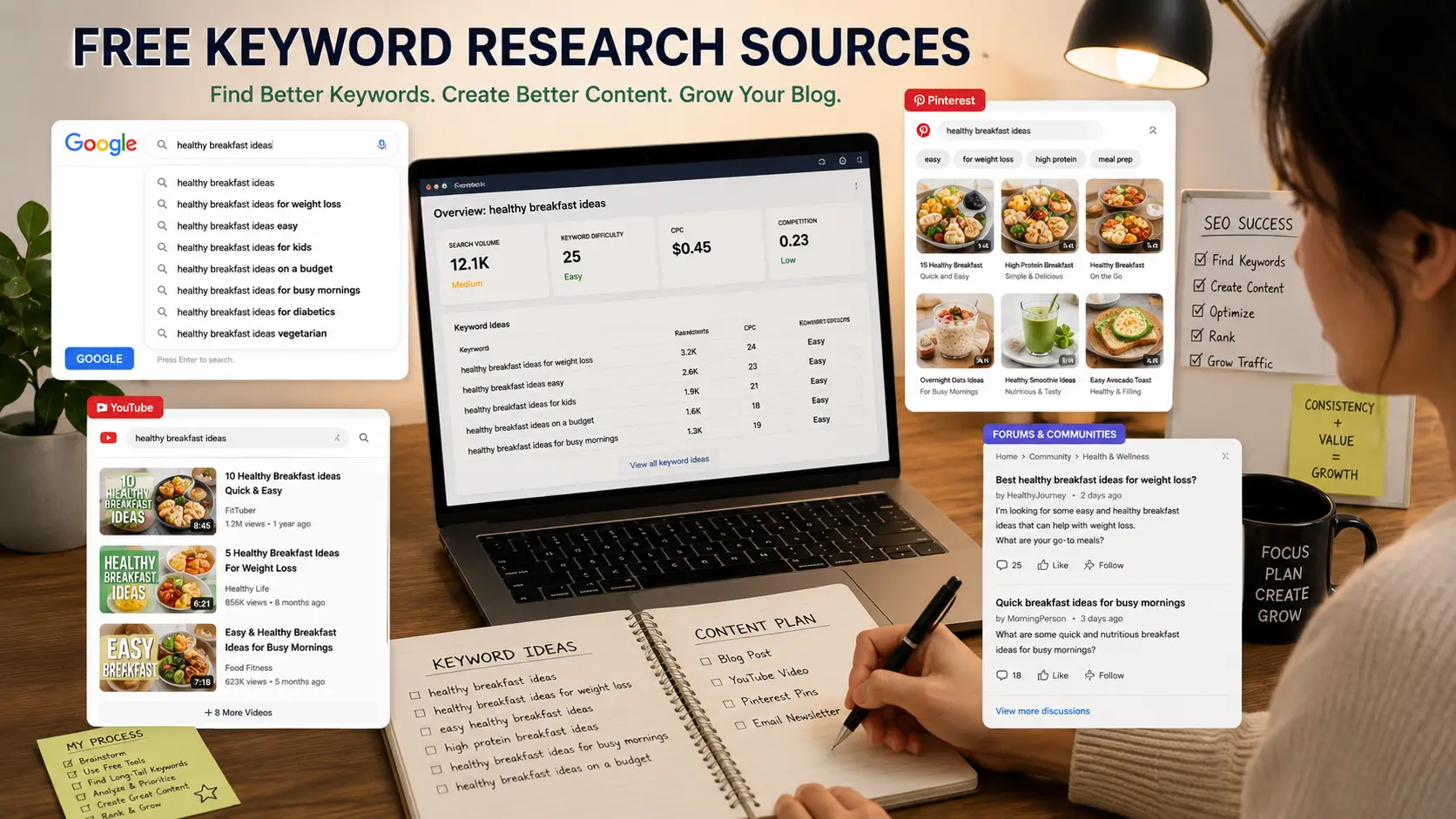
This is one of the easiest and most effective free keyword research methods available. Whenever you type a topic into Google’s search bar, Google automatically displays suggested searches based on real user behavior. For example, if you type: “Pinterest traffic…”
Google may suggest:
- Pinterest traffic strategy
- Pinterest traffic for the blog
- Pinterest traffic tips
- Pinterest traffic for beginners
These suggestions are extremely valuable because they come from actual searches people perform on Google. That means there is already user interest behind those keywords. I still use this method regularly because it helps me:
- Discover long-tail keywords
- Understand what beginners search for
- Find related blog topics
- Generate article ideas quickly
One simple trick I use during Keyword Research for Free is adding different words before or after my main keyword to generate more suggestions. For example:
- “Best Pinterest traffic…”
- “How to get Pinterest traffic…”
- “Pinterest traffic without…”
This often reveals hidden keyword opportunities.
Method 2: Google “People Also Ask”
The “People Also Ask” section is incredibly useful for bloggers. When you search for a keyword on Google, you often see a box containing related questions users commonly ask.
For example:
- How many pins should I post daily?
- Is Pinterest good for blogging?
- Can Pinterest drive traffic to websites?
These questions are powerful because they directly show what users want to know. I frequently use these questions as Blog subheadings, FAQ sections, Content ideas, and supporting article topics.
Sometimes I even build entire sections of an article around “People Also Ask” questions because they naturally improve SEO and user engagement.
This method is especially helpful for creating content that matches search intent more accurately.
Method 3: Related Searches at the Bottom of Google
Another free method I often use is checking the related searches section at the bottom of Google search results. Many beginners ignore this area, but it contains excellent keyword ideas. These related searches help uncover:
- Long-tail keywords
- Related topic ideas
- User intent variations
- Semantic SEO opportunities
For example, while researching “Keyword Research for Free,” Google may also show related searches like:
- Free keyword research tools
- Keyword research for beginners
- How to find low competition keywords
- SEO keyword research tips
These suggestions help expand content coverage and improve topical relevance. I often use them to:
- Plan future blog posts
- Improve article depth
- Discover supporting keywords
- Build internal linking strategies
Method 4: Google Trends
Google Trends is one of the best free tools for understanding keyword popularity and search behavior over time. This tool helped me understand an important lesson: Not every trending topic stays valuable forever. With Google Trends, you can:
- Compare multiple keywords
- Identify rising trends
- Discover seasonal traffic patterns
- Analyze audience interest over time
For example, I often check whether interest in a topic is:
- Increasing
- Stable
- Declining
This helps me avoid writing content around topics that are losing popularity. Google Trends is also useful for finding seasonal content opportunities. Some keywords become popular only during certain months or events, and this tool helps identify those patterns early.
For bloggers doing Keyword Research for Free, this tool is extremely valuable for long-term content planning.
Method 5: YouTube Search Suggestions
YouTube is another powerful platform that many bloggers underestimate for keyword research. When users search on YouTube, they usually want: Tutorials, Step-by-step guidance, Problem-solving content, Reviews, and Beginner explanations. That makes YouTube search suggestions incredibly useful for finding content ideas. For example, typing: “How to start…”
may reveal searches like:
- How to start blogging
- How to start affiliate marketing
- How to start Pinterest marketing
These suggestions reveal real audience interest and common beginner problems. I often use YouTube suggestions to:
- Find tutorial topics
- Discover beginner pain points
- Generate article titles
- Understand content demand
Since video and blog search behavior are often similar, this method works surprisingly well for blog topic research.
Method 6: Pinterest Search
Pinterest is one of my favorite platforms for content inspiration and keyword research, especially for lifestyle and blogging-related niches.
When you type a keyword into Pinterest search, the platform displays suggestion bubbles and related keyword phrases. These are based on popular user searches. Pinterest keyword suggestions work especially well for niches like: Blogging, DIY, Productivity, Fashion, Lifestyle, Home decor, and Recipes.
For example, if you search: “Pinterest traffic.” Pinterest may show suggestion bubbles like: Strategy, Blogging, Tips, Growth, and Marketing. These related terms help identify what users are actively interested in.
Since I personally use Pinterest traffic strategies for blogging, this method helps me discover fresh content ideas regularly.
Method 7: Reddit and Forums
Reddit and online forums are excellent places to understand real audience problems and conversations. This method helped me improve content quality significantly because it reveals what people are genuinely struggling with.
I regularly read:
- Reddit discussions
- Quora questions
- Facebook groups
- Blogging communities
- SEO forums
These platforms reveal:
- Beginner confusion
- Common mistakes
- Frequently asked questions
- Real frustrations
- Trending discussions
Unlike traditional keyword tools, forums show natural human conversations. This helps create more relatable and useful content. Sometimes a single Reddit discussion can inspire:
- Multiple blog posts
- FAQ sections
- Content outlines
- Long-tail keyword ideas
For anyone learning Keyword Research for Free, forums are one of the best ways to understand audience psychology and create content that truly solves problems.
Free Keyword Research Tools I Personally Use
When I first started learning Keyword Research for Free, I thought professional blogging required expensive SEO software. But honestly, beginners do not need costly tools immediately. In the early stages of blogging, free keyword research tools are more than enough to:
- Find keyword ideas
- Understand search demand
- Analyze trends
- Discover low-competition topics
- Build a content strategy
Even today, I still use several free tools regularly because they are simple, fast, and surprisingly effective.
Here are the free keyword research tools I personally use the most.
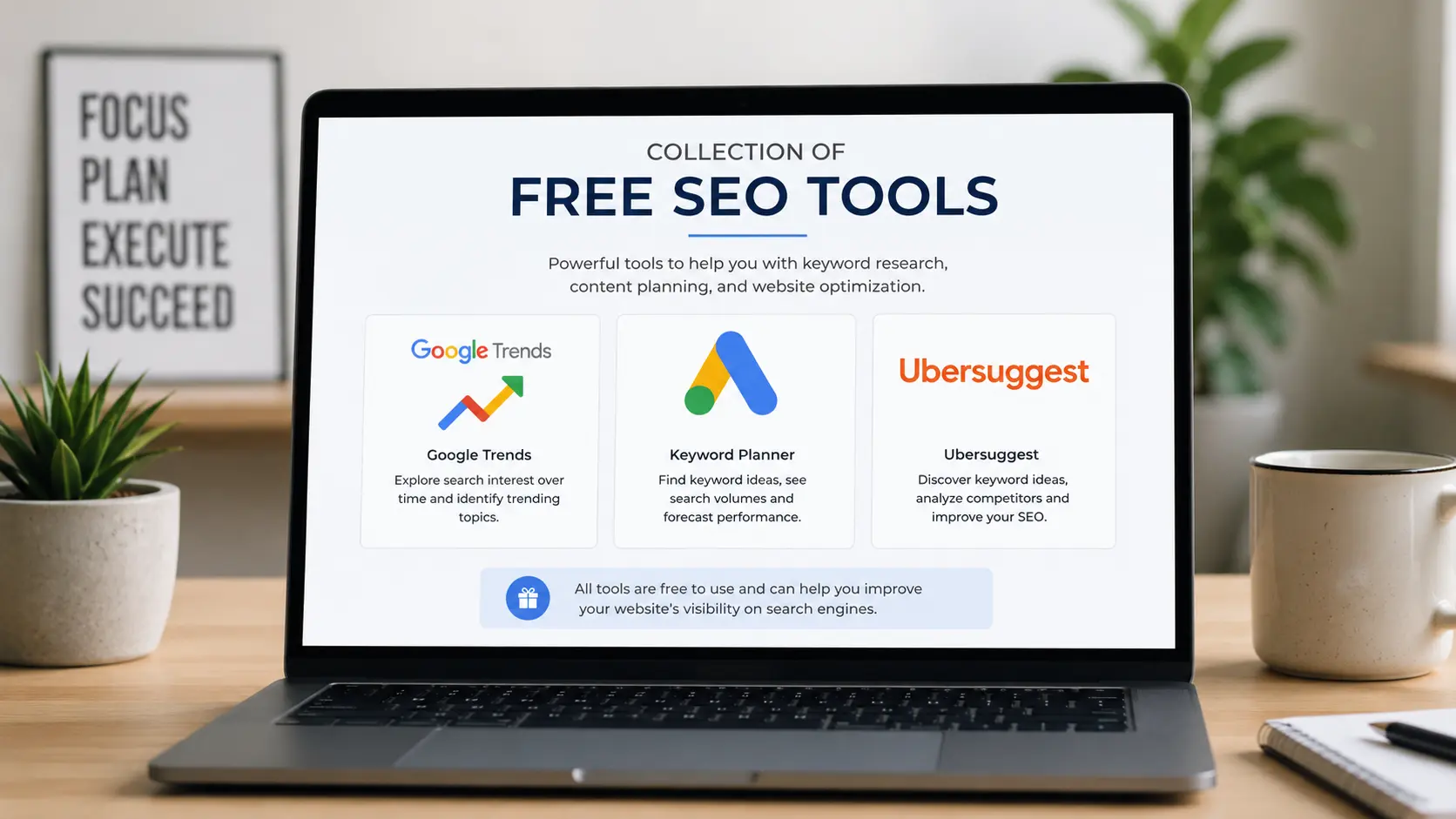
1. Google Keyword Planner
Google Keyword Planner is one of the most popular free keyword research tools available. It is officially designed for advertisers, but bloggers can still use it to discover useful SEO keyword ideas.
I mainly use this tool for:
- Finding related keywords
- Understanding approximate search volume
- Discovering topic variations
- Expanding content ideas
For example, if you search: “Keyword Research for Free.”
Google Keyword Planner may suggest related searches like:
- Free keyword research tools
- SEO keyword research
- Keyword research for beginners
- Long-tail keyword ideas
This helps generate additional blog topics and supporting keywords.
One important thing to understand is that Google Keyword Planner is not perfect for SEO competition analysis. Since the tool focuses more on advertising data, SEO difficulty insights are limited. Still, for free keyword research, it remains extremely useful for beginners.
2. Ubersuggest
Ubersuggest is another beginner-friendly keyword research tool I often recommend. One reason many beginners like Ubersuggest is its simple and easy-to-understand interface. The free version provides useful information such as:
- Keyword ideas
- Search volume
- Basic SEO difficulty
- Content suggestions
- Related keyword variations
When I was learning Keyword Research for Free, Ubersuggest helped me better understand how competitive certain keywords were for smaller blogs. For example, instead of targeting highly competitive terms, I started focusing on lower-difficulty long-tail keywords.
The free version has daily search limits, but it is still very helpful for beginners who want basic SEO insights without paying for premium tools.
3. Ahrefs Free Keyword Generator
Ahrefs Free Keyword Generator is one of the simplest free tools for quickly discovering keyword ideas. I personally like this tool because it is fast and beginner-friendly. You can enter a keyword and instantly get:
- Related keyword ideas
- Question-based searches
- Long-tail keywords
- Basic difficulty insights
This tool is especially useful for finding beginner-friendly content opportunities. For example, searching: “Pinterest traffic” may reveal additional keyword ideas like:
- Pinterest traffic strategy
- Pinterest traffic for blogs
- How to get Pinterest traffic
- Pinterest marketing tips
These keyword variations are excellent for creating multiple related blog posts.
Even though the free version has limited data compared to Ahrefs’ premium tools, it is still highly valuable for free keyword research.
4. Google Trends
Google Trends is one of the most underrated free tools for bloggers. Unlike traditional keyword tools, Google Trends focuses on keyword popularity over time. I personally use it to understand:
- Whether a topic is growing
- Seasonal traffic patterns
- Trending search topics
- Audience interest changes
- Regional keyword popularity
For example, some topics may look interesting today but slowly lose popularity over time. Google Trends helps identify those declining topics before wasting time creating content around them. This tool is also excellent for comparing multiple keywords.
For example, you can compare:
- Pinterest marketing vs Instagram marketing
- Blogging vs affiliate marketing
- AI tools vs SEO tools
This helps make smarter content decisions based on search trends.
Since it is completely free, Google Trends is one of the best tools beginners can use while learning Keyword Research for Free.
5. Keyword Surfer Extension
Keyword Surfer is a Chrome extension that displays keyword data directly inside Google search results. This makes keyword research much faster and more convenient. Instead of opening separate tools, you can instantly see:
- Estimated search volume
- Related keyword ideas
- Similar search queries
- Basic traffic insights
I personally like using Keyword Surfer because it simplifies the research process during normal Google searches. For example, while searching for a keyword like: “Keyword Research for Free.”
The extension may immediately show:
- Monthly search estimates
- Related keywords
- Topic variations
This saves time and helps discover additional content ideas naturally. For beginner bloggers, convenience matters a lot. Simple tools like this make keyword research easier to practice consistently.
And honestly, consistency is one of the biggest keys to successful SEO and blogging growth.
My Simple Keyword Research Strategy (Step-by-Step)
After making many mistakes with random topic selection, I finally developed a simple keyword research process that works much better for beginner blogging.
The best part is that this entire system can be done using Keyword Research for Free methods without expensive SEO tools. My goal is not just to find keywords with traffic. I focus on finding keywords that:
- Beginners can realistically rank for
- Match user intent
- Have genuine search demand
- Fit my blog niche
- Offer long-term traffic potential
This is the exact step-by-step process I personally follow before writing a new article.
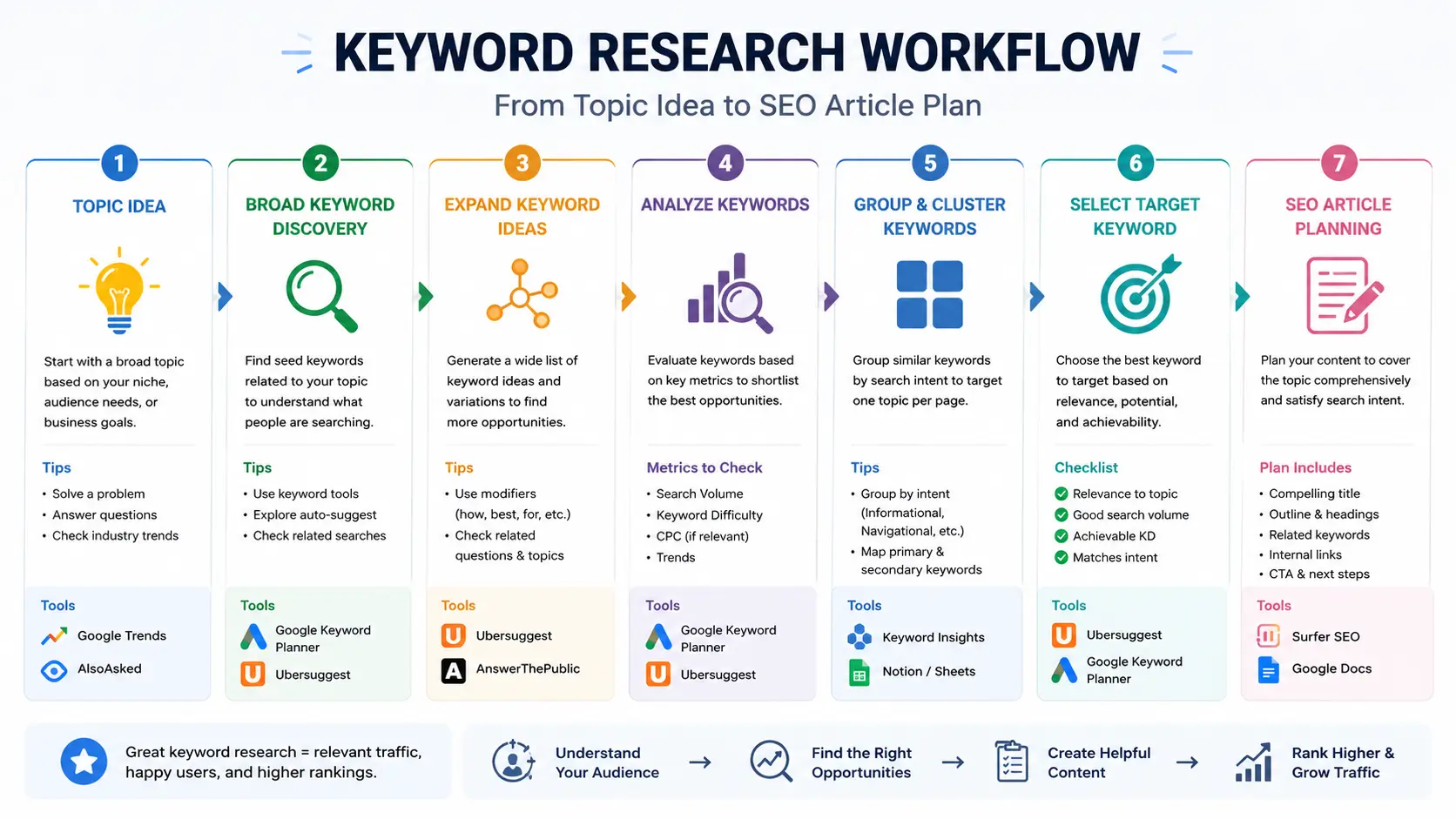
Step 1: Choose a Broad Topic
I always start with a broad niche-related topic. For example:
- Blogging
- Pinterest marketing
- SEO
- Affiliate marketing
- AI tools
Starting broad helps generate multiple keyword ideas later. For example, let’s say I choose: “Blogging.” At this stage, I do not target the broad keyword directly because it is usually too competitive for beginners. Instead, I use it as a starting point for deeper keyword research.
This is an important part of Keyword Research for Free because broad topics help uncover smaller and easier opportunities.
Step 2: Use Google Suggestions
Next, I type the broad topic into Google search and analyze the autocomplete suggestions. Google automatically expands the topic into more specific searches based on real user behavior. For example, typing: “blogging…”
may show suggestions like:
- blogging tips for beginners
- blogging mistakes
- blogging traffic strategy
- blogging for students
- blogging content ideas
These suggestions are extremely valuable because they represent actual searches people make on Google.
This step helps me:
- Discover long-tail keywords
- Understand audience interest
- Generate content ideas quickly
- Find beginner-friendly topics
I often repeat this process multiple times using different keyword variations to uncover more opportunities.
Step 3: Find Long-Tail Keywords
This is one of the most important parts of my strategy. Instead of targeting highly competitive broad keywords, I focus heavily on long-tail keywords. Long-tail keywords are longer, more specific search phrases that usually have:
- Lower competition
- Clearer intent
- Better ranking opportunities for beginners
For example: Difficult keyword: “blogging.” Beginner-friendly long-tail keyword: “How to start blogging without money.” The second keyword is much easier to rank for because:
- Competition is lower
- User intent is clearer
- The audience is more targeted
Long-tail keywords may have smaller search volume individually, but they often bring highly relevant traffic. This strategy helped me achieve my first rankings while learning Keyword Research for Free.
Step 4: Check Competition
Before targeting any keyword, I always analyze the competition manually on Google. This step is extremely important because some keywords look attractive but are almost impossible for beginner websites.
I searched the keyword on Google and carefully studied:
- Which websites are ranking
- Whether smaller blogs appear on page one
- Whether forums rank
- The quality of competing articles
- Whether the results look outdated or weak
One thing I specifically look for is whether low-authority blogs or discussion forums are ranking. If I see:
- Small blogs
- Medium-sized niche sites
- Reddit discussions
- Quora pages
That usually signals lower competition. But if the first page is completely dominated by giant authority websites with extremely strong SEO, I often avoid targeting that keyword initially.
This simple competition analysis saves a huge amount of time and prevents unrealistic keyword targeting.
Step 5: Understand Search Intent
Search intent is one of the most critical parts of successful SEO. Before writing any article, I ask myself one important question: What type of content does Google want for this keyword? Different keywords require different content formats. For example, Google may prefer:
- Tutorials
- Product reviews
- Comparison articles
- Tool pages
- Video content
- Beginner guides
If your content does not match the dominant search intent, ranking becomes much harder. For example:
- A tutorial keyword needs step-by-step guidance
- A comparison keyword needs product comparisons
- A review keyword needs detailed opinions and analysis
That is why I always analyze the top-ranking pages before creating content. Understanding search intent helps improve:
- SEO performance
- User satisfaction
- Content relevance
- Click-through rate
- Time on page
This step alone dramatically improved my Keyword Research for Free strategy.
Step 6: Create Better Content
Once I finalize the keyword, the next goal is simple: Create content that is more helpful, clearer, and more beginner-friendly than competing articles. I focus on creating:
- Easy-to-read explanations
- Practical advice
- Step-by-step guidance
- Human experience and insights
- Better formatting
- Useful examples
- Clear structure and headings
I also try to answer common user questions naturally throughout the article. Google increasingly rewards content that genuinely helps users instead of content created only for search engines. That is why content quality still matters greatly, even after doing proper keyword research.
Keyword research helps attract the right audience, but high-quality content helps keep readers engaged and improves long-term rankings.
This complete process has become my foundation for Keyword Research for Free, and it has helped me create smarter content decisions instead of relying on random guessing.
What Are Long-Tail Keywords?
One of the biggest blogging lessons I learned as a beginner was the importance of long-tail keywords. Honestly, this strategy helped me far more than targeting large competitive keywords. In the beginning, I made the common mistake of targeting broad keywords like SEO, Blogging, Affiliate marketing, and Pinterest.
The problem was that these keywords were extremely competitive. Huge authority websites already dominate the search results, which makes ranking very difficult for a new blog. That is when I discovered long-tail keywords.
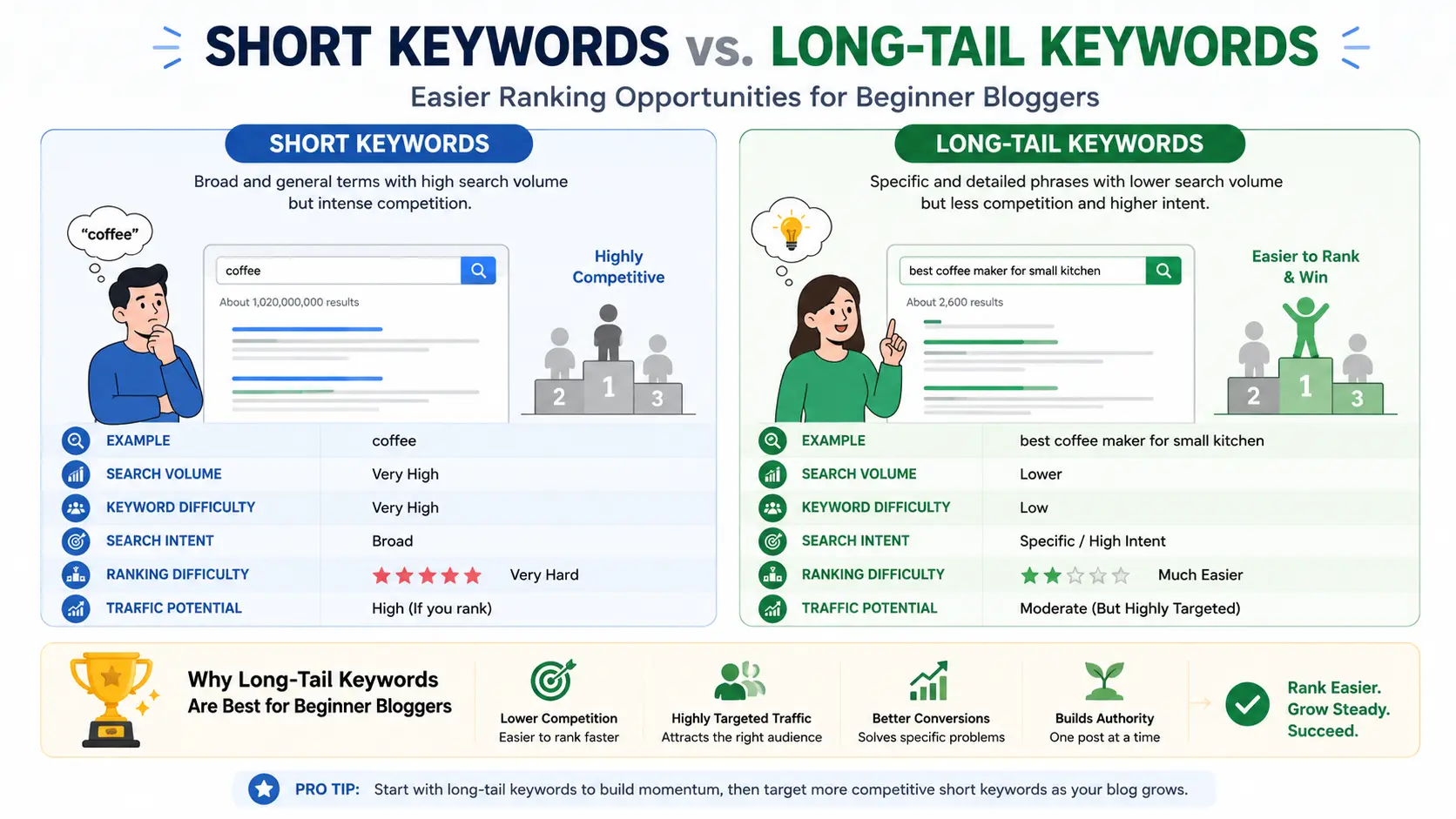
Long-tail keywords are longer and more specific search phrases that usually target a very clear user intent. For example: Highly competitive keyword: “SEO.” Long-tail keyword: ‘How to do SEO for a new blog.”
Another example: Broad keyword: “Blogging.”Long-tail keyword: “How to start blogging without money.”
The second version is much more specific and beginner-focused. This is exactly why long-tail keywords are powerful. Instead of targeting massive audiences broadly, long-tail keywords focus on solving a very specific problem for a smaller audience, and surprisingly, that often makes them much easier to rank for.
Why Long-Tail Keywords Are Important
Long-tail keywords offer several major advantages for beginner bloggers.
1. Lower Competition
This is probably the biggest reason beginners should focus on long-tail keywords. Broad keywords are usually dominated by:
- Large websites
- Established brands
- Strong backlink profiles
- High-authority domains
Competing against those websites can take years. But long-tail keywords often have weaker competition because fewer websites target them directly. For example, ranking for “SEO” is extremely difficult. But ranking for “How to do SEO for a new blog without backlinks” may be much more achievable for a smaller website.
This gives beginner bloggers a realistic chance to appear in Google search results.
2. Easier to Rank on Google
Long-tail keywords are generally easier to rank for because they are more specific. Google prefers content that matches user intent closely. When someone searches a detailed query like: “How to start a blog for free as a student.”
Google wants highly relevant and focused content. If your article directly answers that exact question, your chances of ranking improve significantly. This is why long-tail keywords are one of the smartest Keyword Research for Free strategies for beginners.
Instead of trying to compete everywhere, you target smaller opportunities where ranking is more realistic.
3. Bring More Targeted Visitors
Another major advantage of long-tail keywords is traffic quality. Visitors searching broad keywords are often less specific about what they want. But users searching detailed long-tail keywords usually know exactly what they need.
For example, Someone searching for “Blogging” could mean anything. But someone searching: “How to start a blog without investment,” has a very clear goal. This type of traffic is often:
- More engaged
- More interested
- More likely to stay longer
- More likely to read multiple articles
That improves:
- User engagement
- SEO signals
- AdSense performance
- Affiliate conversion opportunities
In many cases, targeted traffic is more valuable than large amounts of untargeted traffic.
Why Beginners Should Focus on Long-Tail Keywords
For new blogs, long-tail keywords are one of the safest and smartest ways to grow organic traffic. They help beginners:
- Get faster rankings
- Build topical authority
- Understand user intent better
- Gain early Google trust
- Create focused content
When I started targeting long-tail keywords consistently, I finally began seeing small ranking improvements and traffic growth. It was not instant success, but it was realistic progress.
Over time, ranking for multiple smaller keywords helped my blog build authority naturally.
That is why I strongly believe beginners learning Keyword Research for Free should focus heavily on long-tail keywords instead of chasing massive competitive terms too early.
My Real Experience with Long-Tail Keywords
When I first started blogging, I focused mostly on broad and highly competitive keywords because I thought bigger keywords would automatically bring more traffic. So I targeted topics like: SEO, Blogging, Make money online, Affiliate marketing. I spent hours writing detailed articles around those keywords. But almost nothing ranked.
My articles stayed buried in search results, and sometimes they did not appear on Google at all. Even after putting significant effort into content creation, I was getting:
- Very few impressions
- Almost no clicks
- No meaningful rankings
At first, I thought the problem was my writing quality. But later, I realized the real issue was my keyword strategy.
I was competing against massive authority websites that already dominated those broad keywords. As a beginner blogger with a new website, it was extremely difficult to outrank established sites with strong SEO, backlinks, and years of trust from Google.
That is when I started focusing more on long-tail keywords. Instead of targeting broad terms, I began creating content around smaller and more specific searches. For example, instead of “SEO,” I targeted: “How to do SEO for a new blog.” Instead of “Blogging,” I targeted “How to start blogging without money.” That small shift completely changed my blogging results.
After consistently targeting long-tail keywords, I slowly started noticing improvements in Google Search Console. I began getting:
- More impressions
- Small rankings
- Occasional clicks
- Better keyword visibility
At first, the traffic was still small. But the important thing was that Google had finally started recognizing my content.
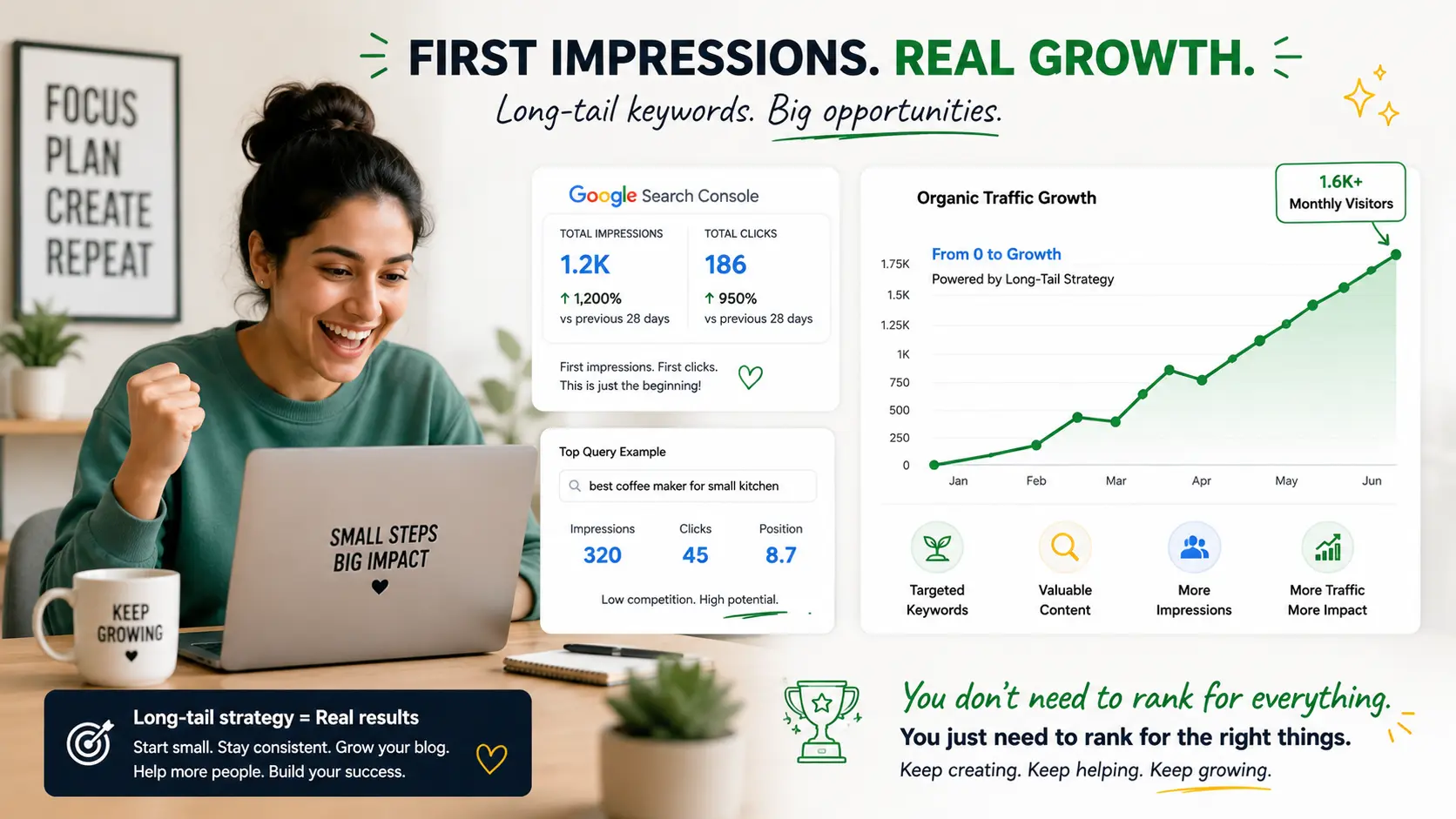
Over time, as I published more beginner-focused long-tail content, my traffic gradually increased. Some articles started ranking on page two, then page one for smaller keywords.
That experience taught me one of the most important lessons in Keyword Research for Free: Small keywords build big blogs over time.
Many beginners ignore low-volume keywords because they want fast viral traffic. But in reality, consistent traffic growth often comes from ranking for dozens or even hundreds of smaller keywords.
Long-tail keywords helped me:
- Build initial Google trust
- Gain early rankings
- Understand user intent better
- Create more focused content
- Attract targeted visitors
- Grow traffic gradually and naturally
And honestly, this strategy is far more realistic for beginner bloggers than trying to compete immediately for massive keywords.
Today, I still use long-tail keywords heavily because they continue to bring targeted traffic and provide better ranking opportunities compared to broad competitive searches.
How I Check Keyword Difficulty for Free
When I first started learning Keyword Research for Free, I believed I needed expensive SEO tools to measure keyword difficulty accurately. But later, I realized that a simple manual analysis can already tell you a lot about whether a keyword is realistic for a beginner blog.
Even today, I still use this method regularly because it is fast, practical, and surprisingly effective. Instead of depending completely on SEO difficulty scores from tools, I manually search the keyword on Google and carefully study the search results. This helps me understand how difficult the competition actually is in real-world rankings.
Here is the simple process I personally follow.

1. Check the Website’s Ranking on Page One
The first thing I analyze is the type of websites ranking for the keyword.
I ask myself:
- Are giant authority websites dominating the results?
- Are smaller niche blogs ranking?
- Do beginner-friendly websites appear?
- Is the competition realistic for a new blog?
If the entire first page is filled with massive websites like large media brands or highly authoritative SEO platforms, ranking becomes much harder, but if I notice: Small blogs, Medium-sized niche websites, Personal blogs, Community forums, then the keyword may have lower competition.
This is often a positive signal for beginners.
2. Analyze Content Quality
Next, I carefully examine the quality of the ranking content. This step is extremely important.
Sometimes high-ranking articles are:
- Outdated
- Poorly formatted
- Too short
- Missing important information
- Difficult to understand
When I see weak or average content ranking on page one, I view it as an opportunity. I ask myself: Can I create something more helpful, more detailed, and easier to understand? If the answer is yes, the keyword becomes more attractive.
Google increasingly rewards helpful content, so better content quality can sometimes outperform stronger websites, especially for lower-competition keywords.
3. Check Whether Forums Are Ranking
One of my favorite beginner SEO signals is seeing forums rank on the first page. For example, if I see results from:
It often means Google does not have many strong authoritative pages for that keyword. This can signal lower competition. Forums usually rank when:
- Search intent is conversational
- Existing content is weak
- Google wants real user discussions
- Content opportunities still exist
Whenever I see multiple forum pages ranking, I pay close attention because it may be a good opportunity for beginner bloggers.
4. Check Whether Small Blogs Rank
This is another major factor I use during Keyword Research for Free. If I notice small or low-authority blogs ranking on page one, it gives me confidence that the keyword is achievable. I specifically look for:
- Simple niche blogs
- Beginner websites
- Low-authority domains
- Blogs without massive branding
Because if smaller websites can rank, there is a good chance another smaller blog can compete too.
But if every ranking result comes from giant companies with extremely strong SEO, backlinks, and domain authority, I usually avoid targeting that keyword initially.
Why This Manual Method Works
Many beginners become obsessed with SEO difficulty scores from paid tools. But honestly, manual analysis often provides a more realistic understanding of competition.
SEO tools sometimes label keywords as “easy,” but the actual search results may still be dominated by huge authority websites. That is why I prefer checking the search results directly.
My basic strategy is simple:
- If the competition looks weak, I target the keyword
- If the first page looks impossible, I move on
- If small blogs are ranking, I consider it a good sign
This manual approach helped me make smarter content decisions without spending money on expensive software. And honestly, for beginners learning Keyword Research for Free, simplicity is often better than overcomplicating SEO.
Common Keyword Research Mistakes to Avoid
When I first started learning Keyword Research for Free, I made several mistakes that slowed down my blog growth significantly.
At that time, I focused more on writing content quickly instead of understanding how keyword strategy actually works. As a result, I wasted time creating articles that had little chance of ranking.
Over time, I realized that avoiding a few common mistakes can save beginners months of frustration. These are the keyword research mistakes I personally recommend avoiding.
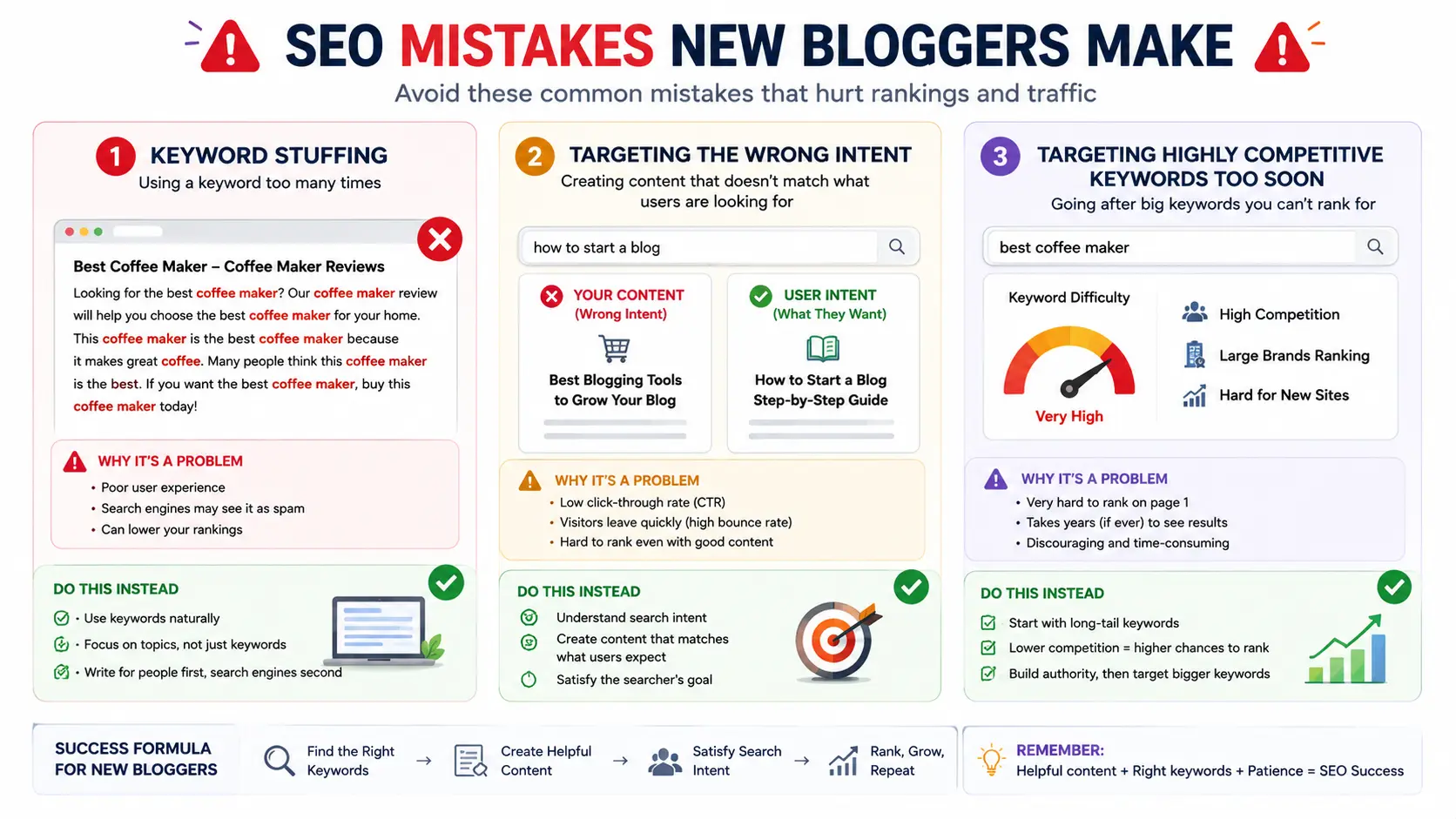
1. Targeting Huge Keywords Too Early
This is probably the most common beginner mistake. Many new bloggers immediately try targeting massive keywords like: SEO, Blogging, Affiliate marketing, and Make money online. The problem is that these keywords are extremely competitive.
Large authority websites already dominate those search results with:
- Strong backlinks
- High domain authority
- Experienced SEO teams
- Thousands of indexed pages
For a new blog, competing against those websites is very difficult. I made this mistake myself in the beginning. I spent hours writing content for broad competitive keywords, but almost nothing ranked.
Things improved only when I started targeting:
- Long-tail keywords
- Smaller search phrases
- Low-competition topics
- Specific user problems
Beginners should focus on realistic opportunities first instead of chasing huge keywords immediately. Small rankings build authority over time.
2. Ignoring User Intent
Another major mistake is focusing only on keywords while ignoring user intent. Many beginners think SEO is simply about placing keywords inside articles.
But Google cares much more about whether the content actually matches what users want. For example, some keywords require: Tutorials, Product comparisons, Reviews, Tool pages, Step-by-step guides.
If your content format does not match search intent, ranking becomes much harder. I learned this lesson after creating articles that were informative but still failed to rank because Google preferred different content types for those searches.
Now, before writing any article, I always analyze:
- What type of content ranks on page one
- What users likely expect
- Whether the keyword has informational or commercial intent
- How competitors structure their content
Understanding intent is one of the most important parts of successful Keyword Research for Free.
3. Only Looking at Search Volume
In the beginning, I believed higher search volume automatically meant a better keyword. That assumption caused many bad keyword decisions.
A keyword may have:
- Massive search volume
- High traffic potential
- Strong advertiser interest
but still be a poor opportunity for beginners if the competition is extremely difficult. Sometimes, smaller keywords with:
- Lower competition
- Clear intent
- Easier rankings
It can bring better results for a new blog.
For example, A keyword with 300 monthly searches but low competition may be far more valuable than a keyword with 50,000 searches dominated by huge websites. This is why I no longer choose keywords based only on volume.
I also consider:
- Competition level
- Search intent
- Ranking potential
- Content quality opportunities
Smart keyword selection matters more than chasing large numbers.
4. Copying Competitors Blindly
Competitor research is helpful, but blindly copying competitors is a mistake. Earlier, I sometimes tried imitating top-ranking articles too closely because I thought copying their structure would guarantee rankings.
But that approach usually creates generic content. Google prefers content that provides unique value and genuine usefulness. Now, I still study competitors carefully, but I focus on:
- Improving weak sections
- Adding better explanations
- Including practical experience
- Making content more beginner-friendly
- Providing clearer formatting
The goal is not to create duplicate content. The goal is to create better and more helpful content. Learning from competitors is smart. Copying them completely is not.
5. Not Using Long-Tail Keywords
This mistake delayed my blog growth the most. For a long time, I ignored long-tail keywords because they looked “too small.” That was a huge mistake. Long-tail keywords are often:
- Easier to rank
- Less competitive
- More targeted
- Better for beginners
- Stronger for user intent
For example: Highly competitive keyword: “SEO,” Long-tail keyword: “How to do SEO for a new blog.” The second keyword is far more realistic for beginner bloggers. Once I started focusing heavily on long-tail keywords, I finally began getting:
- Impressions
- Clicks
- Small rankings
- Consistent traffic growth
That experience taught me an important lesson: Long-tail keywords are beginner gold.
Instead of trying to compete for massive keywords immediately, beginners should build traffic gradually through smaller, targeted search phrases.
Over time, those small rankings help build authority and improve overall SEO performance naturally.
My Daily Keyword Research Routine
When I first started blogging, I thought keyword research needed complicated spreadsheets, expensive SEO tools, and hours of analysis every day. But over time, I realized something important: Simple and consistent keyword research works far better than overcomplicated systems.
Today, my daily Keyword Research for Free routine is actually very simple. I focus more on consistency and smart topic selection rather than spending endless hours researching keywords.
Most days, I spend around 20–30 minutes on keyword research. That small daily habit has helped me generate a large number of blog ideas over time. Here is the simple process I personally follow.
1. Spend 20–30 Minutes Researching
I usually start by exploring:
- Google search suggestions
- Related searches
- Pinterest search ideas
- YouTube suggestions
- Reddit discussions
- “People Also Ask” questions
The goal is not to find perfect keywords immediately. The goal is to discover:
- Real audience problems
- Beginner questions
- Long-tail keyword opportunities
- Trending content ideas
Even a short research session can reveal dozens of potential topics.
One thing I learned is that keyword research becomes easier with practice. The more consistently you do it, the faster you start recognizing good opportunities.
2. Save Keyword Ideas in Notes
Whenever I find interesting keywords, I immediately save them. Earlier, I used to trust my memory, but I often forgot valuable ideas later. Now I store everything inside simple notes or spreadsheets. I usually save:
- Keyword ideas
- Long-tail variations
- Blog title ideas
- Search intent notes
- Content angles
- Related topic ideas
This creates a growing keyword database over time. Sometimes a keyword I ignore today becomes useful later when my blog gains more authority. Saving ideas consistently helps avoid losing good opportunities.
3. Group Related Keywords Together
One strategy that improved my SEO significantly was grouping related keywords together. Instead of targeting only one isolated keyword, I organize similar topics into clusters. For example:
- Keyword Research for Free
- Free keyword research tools
- Beginner keyword research tips
- How to find low competition keywords
All these topics are closely related. Grouping keywords helps:
- Build topical authority
- Improve internal linking
- Create better content structure
- Cover user intent more deeply
Google generally prefers websites that publish multiple related articles around a topic instead of random disconnected content. This strategy also makes content planning much easier.
4. Choose Easy Opportunities First
Earlier, I wasted time targeting unrealistic keywords. Now I focus mostly on:
- Long-tail keywords
- Low-competition topics
- Beginner-friendly opportunities
- Weak search result pages
If I notice:
- Small blogs ranking
- Weak content
- Outdated articles
- Forum discussions on page one
I consider that a good opportunity. This approach helped me get early rankings much faster compared to chasing huge competitive keywords.
One important lesson I learned is this: You do not need to rank for massive keywords immediately to grow a successful blog. Small, consistent wins matter more.
Consistency Matters More Than Perfection
One of the biggest mistakes beginners make is overthinking keyword research. They spend weeks trying to find the “perfect” keyword instead of actually publishing content.
But in real blogging, consistency matters much more than perfection. Some keywords will work better than expected. Some will fail. That is normal. The important thing is continuing to:
- Research regularly
- Publish consistently
- Learn from rankings
- Improve your strategy gradually
Over time, this process becomes easier and much more natural. My Keyword Research for Free strategy is still simple today, but consistency is what helped it become effective.
How Keyword Research Helped My Blog Grow
Learning Keyword Research for Free completely changed the direction of my blogging journey. Before understanding keyword research properly, my entire content strategy was based mostly on guessing.
I wrote articles on topics that seemed interesting to me personally, without checking whether people were actually searching for them. At that time, my blog had several problems:
- Random traffic
- Almost no rankings
- Weak SEO direction
- Poor content planning
- Very little consistency in results
Some articles received impressions while others received nothing at all. I kept publishing content, but I had no clear strategy behind what I was creating. That made blogging feel frustrating.
I spent a lot of time writing articles, yet I rarely saw meaningful growth in Google Search Console. Sometimes it felt like all the effort was going nowhere. The biggest issue was simple: I did not understand what people actually wanted to search for.
Everything started changing once I began learning Keyword Research for Free and applying it consistently before writing articles.
Better Topic Selection
One of the first improvements I noticed was smarter topic selection. Instead of randomly choosing blog ideas, I started researching:
- What users were searching for
- Which topics had lower competition
- What type of content ranked on Google
- Which long-tail keywords could beginners realistically target
This immediately improved the quality of my content decisions. Earlier, I created content based on assumptions. Now, I create content based on actual search demand. That difference changed everything.
More Impressions and Better Visibility
After targeting better keywords, I slowly started seeing improvements in Google Search Console. At first, the changes were small:
- More impressions
- A few clicks
- Small keyword rankings
But those small improvements were extremely important because they showed that Google was finally understanding and indexing my content more effectively.
Instead of competing for impossible broad keywords, I focused more on:
- Long-tail keywords
- Beginner-focused searches
- Specific problems
- Lower competition topics
This gave my articles a much better chance of appearing in search results. Over time, multiple small rankings started building consistent traffic naturally.
Improved SEO Direction
Keyword research also gave me something I lacked earlier: a clear direction. Before learning SEO properly, my blog strategy felt confusing. I published random articles without understanding how they connected.
Now, keyword research helps me:
- Plan content more strategically
- Build topic clusters
- Improve internal linking
- Understand search intent
- Create more relevant articles
Instead of writing blindly, I now have a structured content approach. That makes blogging much more organized and productive.
Blogging Feels Less Frustrating Now
Honestly, one of the biggest benefits of Keyword Research for Free is psychological. Blogging feels far less frustrating now because I no longer rely completely on guessing.
I understand:
- What people want
- What users search for
- Which topics have potential
- What type of content does Google prefer
That clarity makes content creation much easier. Of course, not every article ranks perfectly, and SEO still takes time. But keyword research significantly improved my confidence because I know my content strategy is based on real search behavior instead of random assumptions, and in blogging, that strategic clarity matters a lot.

Conclusion
When I first started blogging, I thought success depended only on writing good articles. But over time, I realized something extremely important: Even great content struggles if nobody is searching for it.
That is why learning Keyword Research for Free completely changed my blogging approach. Instead of guessing topics randomly, I now create content based on:
- Real search demand
- User intent
- Low-competition opportunities
- Long-tail keywords
- Practical SEO strategy
This helped me improve:
- Topic selection
- Google impressions
- Organic traffic
- Content planning
- Overall blogging confidence
And honestly, keyword research is not as complicated as many beginners think. You do not need expensive SEO tools or advanced technical knowledge to get started. Free methods like:
- Google search suggestions
- People Also Ask
- Related searches
- Google Trends
- Pinterest search
- YouTube suggestions
- Reddit discussions
can already provide powerful keyword ideas if used consistently. The biggest lesson I learned is this: Small, targeted keywords are often better for beginners than huge, competitive keywords. Instead of chasing massive traffic immediately, focus on:
- Long-tail keywords
- Beginner-friendly opportunities
- Helpful content
- Consistency
Over time, those small rankings can grow into significant organic traffic.
Keyword research will not make a blog successful overnight, but it gives your content a clear direction and increases your chances of ranking on Google. Once you start understanding what people truly search for, blogging becomes far less confusing and much more strategic. If you are a beginner, start simple.
Practice Keyword Research for Free regularly, stay consistent, keep learning from your results, and focus on creating genuinely helpful content.
That combination can make a huge difference in your blogging journey over time.
Frequently Asked Questions (FAQs)
1. What is keyword research in blogging?
Keyword research is the process of finding the words and phrases people search on Google. Bloggers use these keywords to create content that matches user interest and improves chances of ranking in search results.
2. Why is keyword research important for SEO?
Keyword research helps bloggers understand what users actually want. It improves content planning, search visibility, organic traffic, and overall SEO strategy.
3. Can beginners do Keyword Research for Free?
Yes. Beginners can easily start Keyword Research for Free using tools and methods like Google search suggestions, Google Trends, Pinterest search, YouTube suggestions, and related searches.
4. What are long-tail keywords?
Long-tail keywords are longer and more specific search phrases. They usually have lower competition and are easier for beginners to rank for on Google.
Example:
- Broad keyword: “SEO.”
- Long-tail keyword: “How to do SEO for a new blog.”
5. Why are long-tail keywords important for beginners?
Long-tail keywords are important because they:
- Have lower competition
- Match user intent better
- Bring targeted visitors
- Offer easier ranking opportunities for new blogs
6. How do I find low-competition keywords for free?
You can manually check the competition by searching the keyword on Google and analyzing:
- Whether small blogs rank
- Whether forums appear
- Content quality
- Strength of competing websites
7. What is search intent in keyword research?
Search intent refers to the reason behind a user’s search. Some users want tutorials, some want product comparisons, while others want reviews or quick answers. Understanding intent helps create better SEO content.
8. Which free keyword research tool is best for beginners?
Some of the best free tools for beginners include:
9. How long should keyword research take daily?
Beginners can start with just 20–30 minutes daily. Consistent research matters more than spending hours occasionally.
10. Should I target high-volume keywords as a beginner?
Usually no. High-volume keywords are often very competitive. Beginners should focus more on low-competition long-tail keywords first.
11. How do I know if a keyword is too competitive?
A keyword may be too competitive if:
- Huge authority websites dominate page one
- No small blogs rank
- Content quality is extremely strong
- Search results are highly optimized
12. Does search volume matter a lot?
Search volume matters, but it should not be the only factor. Lower-volume keywords with weak competition can still bring valuable traffic.
13. What is the easiest way to find blog topic ideas?
One of the easiest methods is using Google autocomplete suggestions. These suggestions come from real searches users make every day.
14. Can Pinterest help with keyword research?
Yes. Pinterest search suggestions reveal popular user interests and keyword ideas, especially for blogging, lifestyle, productivity, DIY, and visual content niches.
15. Is Google Trends useful for bloggers?
Yes. Google Trends helps bloggers analyze:
- Trending topics
- Seasonal search patterns
- Keyword popularity over time
- Rising search interests
16. Should I use the exact keyword many times?
No. Keyword stuffing can hurt readability and SEO. Use your target keyword naturally throughout the article while focusing on helpful content.
17. What is the biggest keyword research mistake beginners make?
One of the biggest mistakes is targeting highly competitive broad keywords too early instead of focusing on realistic long-tail opportunities.
18. How many keywords should one article target?
Usually, one main keyword and several related secondary keywords are enough for a well-optimized article.
19. Can free keyword research methods really work?
Yes. Many successful bloggers started with free keyword research methods before investing in premium SEO tools.
Consistency and smart topic selection matter more than expensive software in the beginning.
20. What is the most important lesson about keyword research?
The biggest lesson is that creating content people are already searching for gives your blog a much better chance of getting traffic and growing over time.